
Sprinkler irrigation guide
Sprinkler Irrigation Systems in Sri Lanka: Selection Guide
Compare sprinkler types by the area that must be wetted, the water source, pressure at the sprinkler, wind exposure, soil intake and the verified product data for the selected nozzle.
Quick answer
Choose by site conditions and product data, not by crop name alone
Sprinkler irrigation distributes pressurised water through nozzles and usually depends on overlapping wetted patterns. It may suit broad surface wetting, portable field irrigation or small-area overhead application, but it is not automatically the best method for every crop, water source or site.
What must be wetted?
Decide whether the surface, canopy or a defined area can receive distributed spray. If only a narrow root zone should be wetted, another irrigation method may fit better.
Can water and pressure hold?
The source and pump must sustain the whole operating zone at the required pressure, not just produce water at the pump outlet.
Will wind and soil allow it?
Wind can move spray, and soil can only absorb water at a practical field rate. Check both before setting spacing or runtime.
Do not fill missing product data with estimates
If a product page does not show pressure, discharge, wetted diameter and spacing data for the exact model and nozzle, leave those values blank until verified. The guide is a selection framework, not a substitute for measured product performance.
Method choice
First decide whether sprinkler irrigation fits the task
| Question | Sprinkler may fit when | Recheck when |
|---|---|---|
| What must be wetted? | The intended surface or canopy can receive distributed spray. | Only a narrow root zone should be wetted, or keeping foliage dry is important. |
| Can the supply hold pressure and flow? | The source and pump can meet the entire zone at the required operating point. | Only low or highly variable flow is available. |
| How exposed is the site? | The layout can be tested and operated under suitable wind conditions. | Wind regularly distorts the spray pattern or causes drift outside the intended area. |
| Can the soil accept the rate? | Average application stays below field intake and does not produce runoff. | Ponding, crusting, erosion or flow down the rows appears. |
| Can the system be checked? | Pressure, flow, nozzle condition and field distribution can be measured. | The system would be operated without gauges, product data or a uniformity check. |
Selection framework
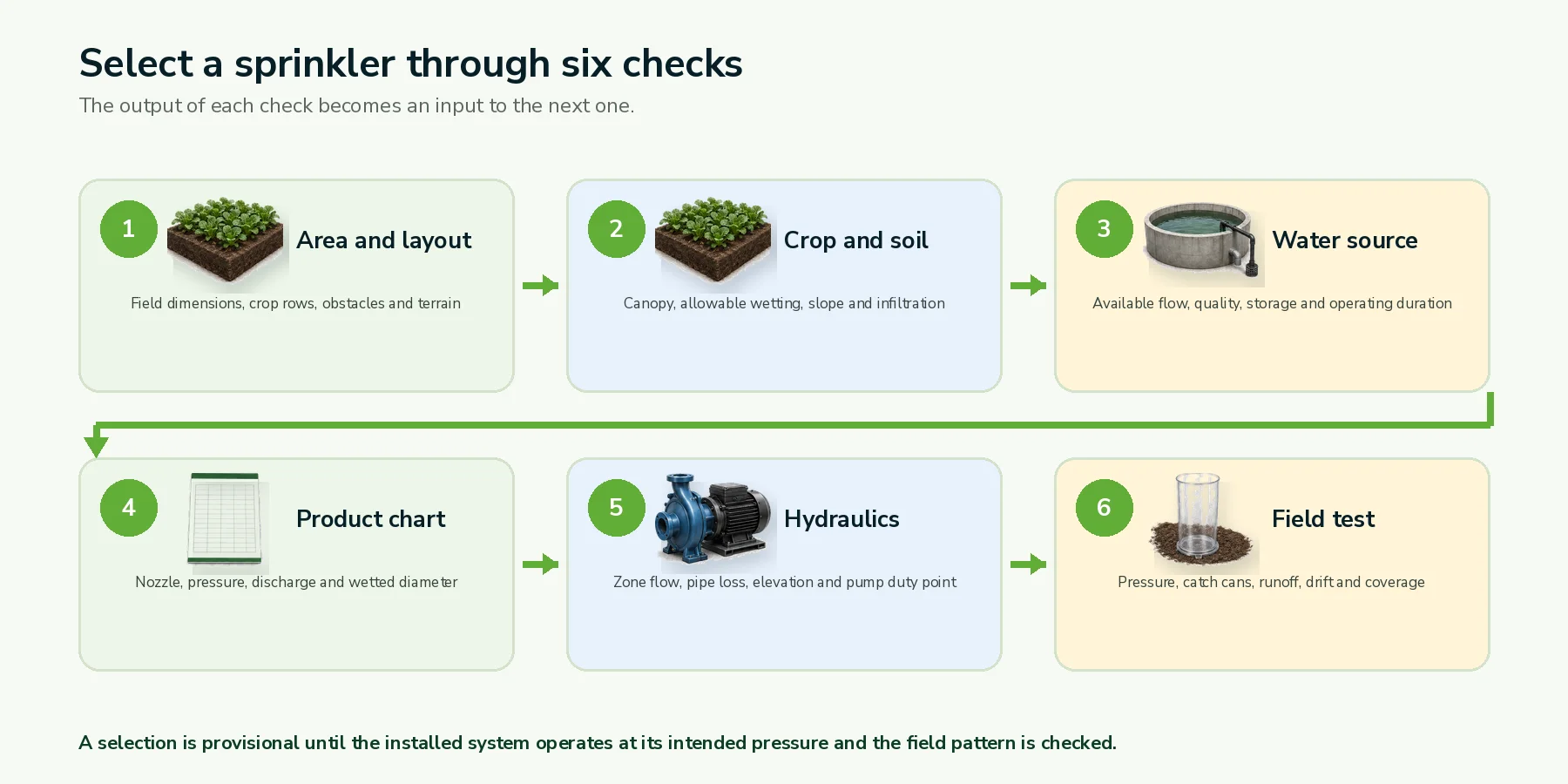
Use six checks before selecting a product
Write down the field dimensions, crop layout, allowable wetting, soil surface condition, water-source flow, water quality, wind exposure and elevation changes before comparing products.
Record the assumptions
Unrecorded assumptions are the main source of false precision. A short written worksheet is better than choosing from product appearance or connection size alone.
Product types
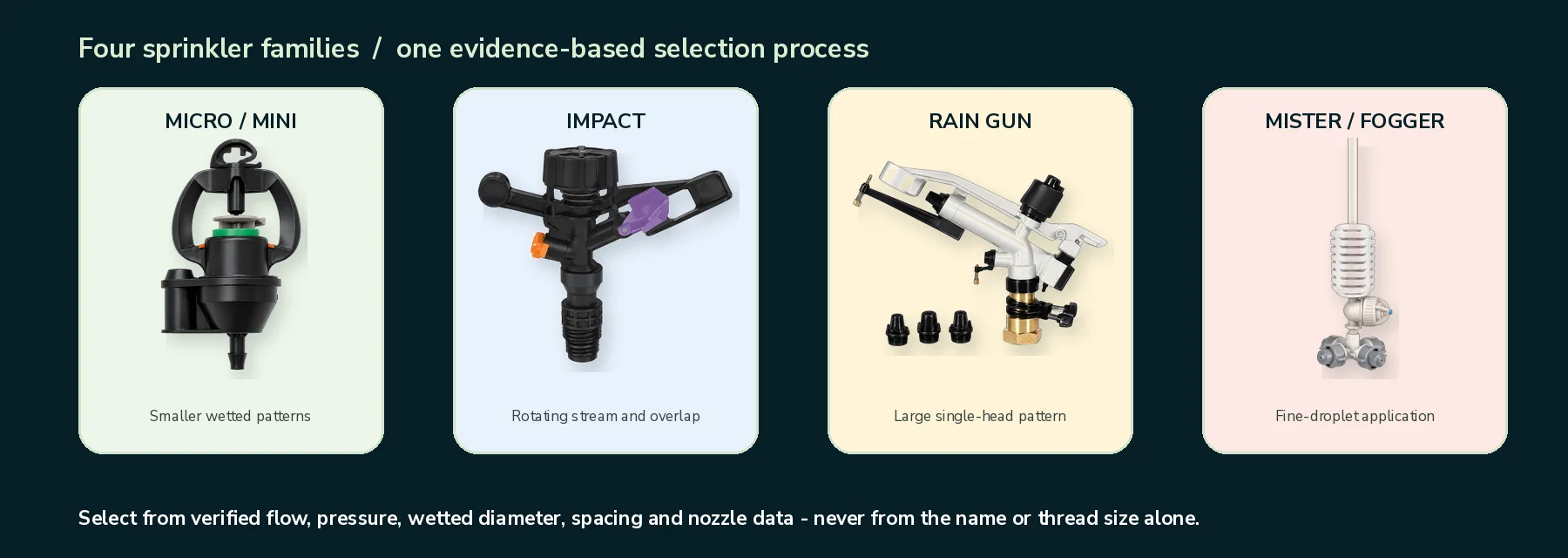
Compare sprinkler families by the job they must perform
Product names do not establish pressure, radius, spacing, droplet size or suitability. Use the exact product data for the selected model and nozzle.
| Family | May be considered for | Evidence required | Main caution |
|---|---|---|---|
| Mini, micro or small rotating sprinklers | Smaller wetted areas, closer spacing, hanging layouts or lower-discharge applications. | Flow-pressure relationship, wetted pattern, mounting height and spacing. | A small head can still apply too fast when spacing is too close. |
| Impact sprinklers | Stationary, portable or solid-set layouts that require overlapping rotary patterns. | Nozzle options, operating pressure, discharge, wetted diameter, arc function and spacing. | Low or high pressure changes droplet breakup and distribution. |
| Rain guns | Layouts needing a large wetted pattern from fewer or movable positions. | Nozzle, pressure, flow, trajectory, arc, wetted diameter, movement and anchoring. | High zone demand, wind distortion and surface runoff must be checked. |
| Misters or foggers | Fine-droplet applications where the intended environmental or wetting effect is clearly defined. | Droplet purpose, pressure, flow, pattern, spacing, filtration and mounting. | Fine droplets are wind-sensitive and are not automatically a field-irrigation substitute. |
| Blade, rotor or spray types | Small rotating or spray uses where a verified chart matches the area. | Operating range, flow, radius or diameter, pattern and connector details. | The visible shape of the product does not reveal performance. |
Product data
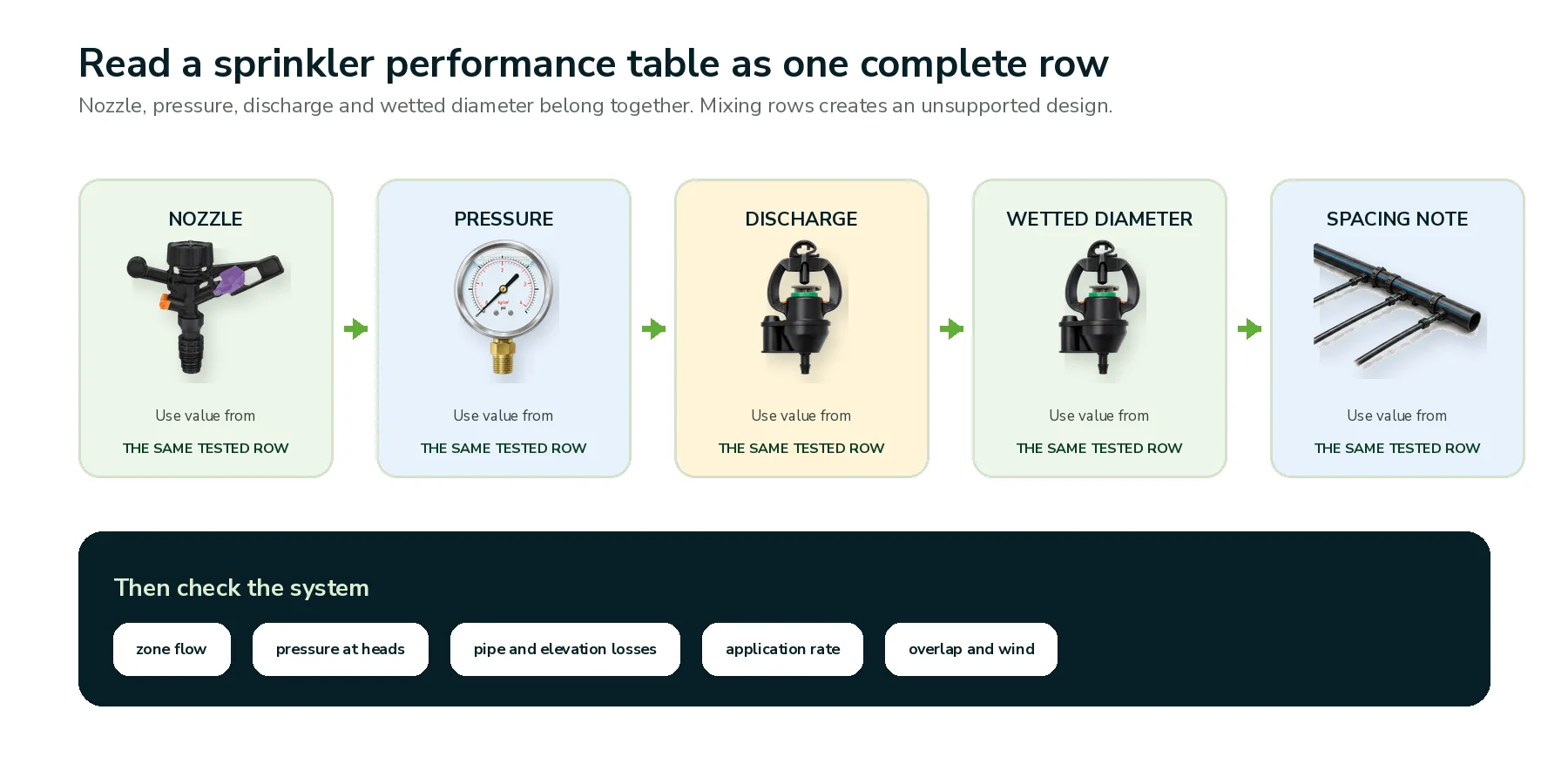
Require a complete performance row for the exact sprinkler
A useful sprinkler comparison needs one complete operating row for the exact nozzle, pressure and layout condition.
Minimum data to record
Model and nozzle
Exact model, nozzle size or colour, full-circle or part-circle option and connection.
Operating pressure
Required pressure measured at the sprinkler while the complete zone is running.
Discharge
Flow for that exact nozzle and pressure, not a value copied from another model.
Wetted diameter
Tested diameter or radius for the same operating row and mounting condition.
Spacing guidance
Layout spacing for the operating row, with any wind-related reduction clearly recorded.
Mounting and filtration
Required height, orientation, filter level and any regulator or anti-drain feature.
Zone flow
Calculate the flow required by one operating zone
A zone is the group of sprinklers that runs at the same time. Its design flow comes from the verified discharge of every operating sprinkler, including different edge or part-circle heads.
Core formula
Zone flow = sum of the verified sprinkler discharges. For identical heads: Qzone = number of operating sprinklers × qsprinkler. When q is in L/h, divide the total by 1,000 to express it in m3/h.
Draw zones
Mark which sprinklers operate together. Do not count every head on the farm if only one zone runs.
Read each flow
Take discharge from the exact nozzle-pressure row and keep units consistent.
Add all outlets
Include different boundary nozzles, part-circle heads and any other simultaneous demand.
Compare with source
The available water supply must sustain the zone for the full operating period.
Compare with pump
Use the pump curve at the required total head, not the pump maximum-flow label.
Measure in operation
A flow meter or timed calibrated method can confirm actual zone flow after installation.
Blank selection worksheet
| Zone | Heads running | Verified flow per head | Calculated zone flow | Measured flow |
|---|---|---|---|---|
| A | ___ | ___ L/h | ___ m3/h | ___ m3/h |
| B | ___ | ___ L/h | ___ m3/h | ___ m3/h |
| C | ___ | Mixed – list separately | ___ m3/h | ___ m3/h |
Pressure and pump
Match pressure at the sprinkler, not only at the pump
The sprinkler must receive its required operating pressure while the full zone is running. The pump also has to overcome elevation, pipe friction and losses through valves, filters and fittings.
Sprinkler pressure
Use the exact operating range for the selected nozzle and pattern.
Elevation
Water sent uphill loses pressure; water sent downhill gains pressure. Map the field levels.
Pipe friction
Long, narrow or high-flow pipework loses more pressure. Use the actual pipe material, size and route.
Component losses
Allow for measured or published loss through valves, filters, fittings and controls.
Pump duty point
Compare required flow and total dynamic head with the pump performance curve at the same point.
Operating check
Measure pressure near the first and hydraulically remote sprinklers with the zone running.
Symptoms are not specifications
Large drops and a weak throw can indicate low pressure. Excessive misting can indicate pressure above the suitable range. A pressure gauge is needed before changing nozzles or the pump.
Spacing and uniformity
Design for overlapping patterns and actual wind
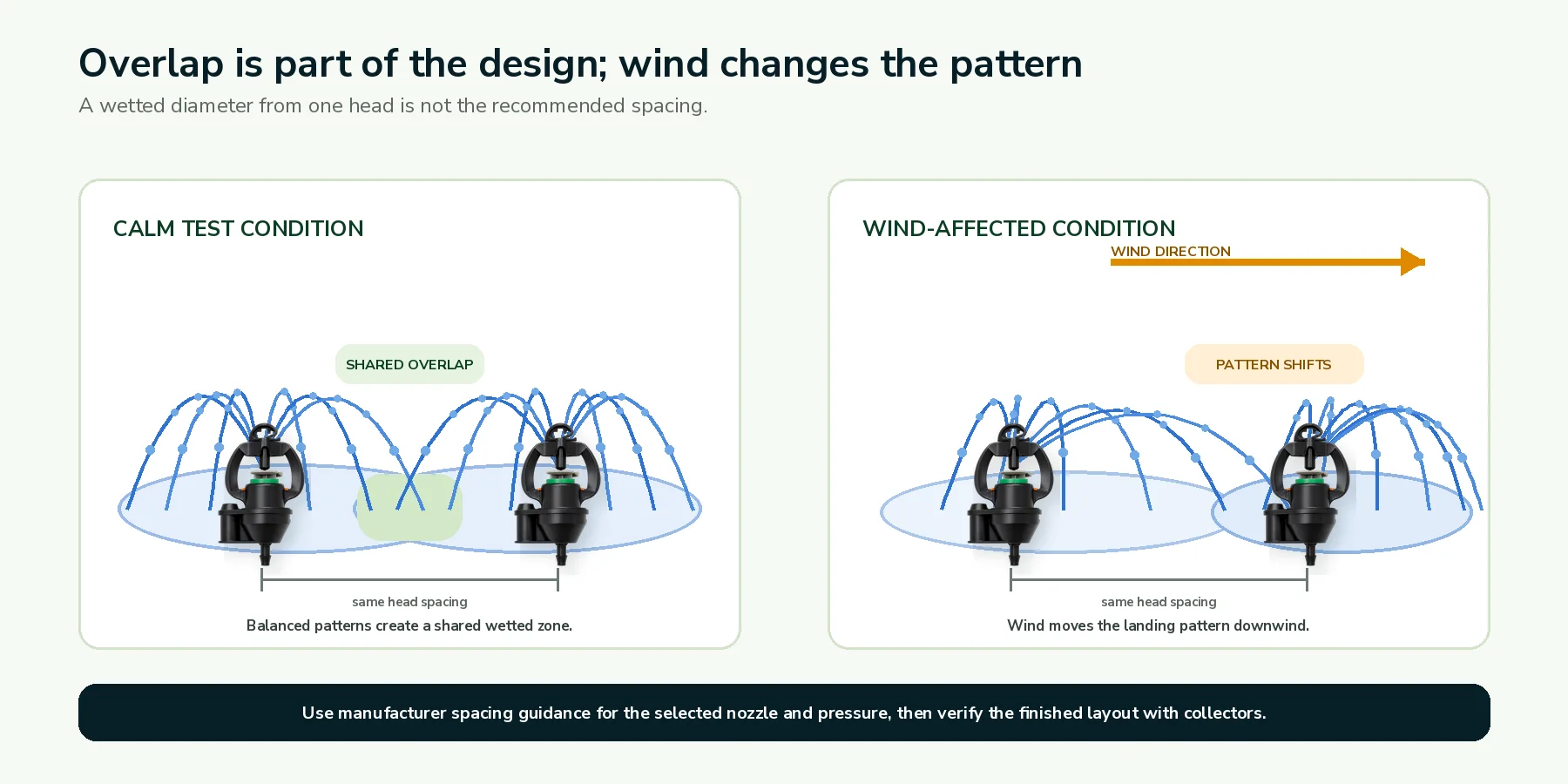
The outer reach of one sprinkler is not automatically the spacing. Neighbouring patterns must overlap so low-water edges receive water from more than one head.
Wetted diameter
The outside reach of one tested pattern under the stated operating condition.
Overlap
Neighbouring patterns are combined so the intended area receives a more even distribution.
Wind
Wind can shift fine droplets and reduce useful pattern control, especially for small droplets.
Boundaries
Field edges and part-circle operation need a layout that limits water outside the intended area.
Height
Mounting height changes the pattern and wind exposure, so it should match the selected product layout.
Testing
Collector readings are more reliable than judging the pattern by eye.
Application rate
Keep the average application rate below the soil intake
If water is applied faster than the soil surface can absorb it, ponding, movement down the rows, runoff or erosion can occur. Soil texture alone is not enough; slope, surface condition, compaction and current moisture also affect field intake.
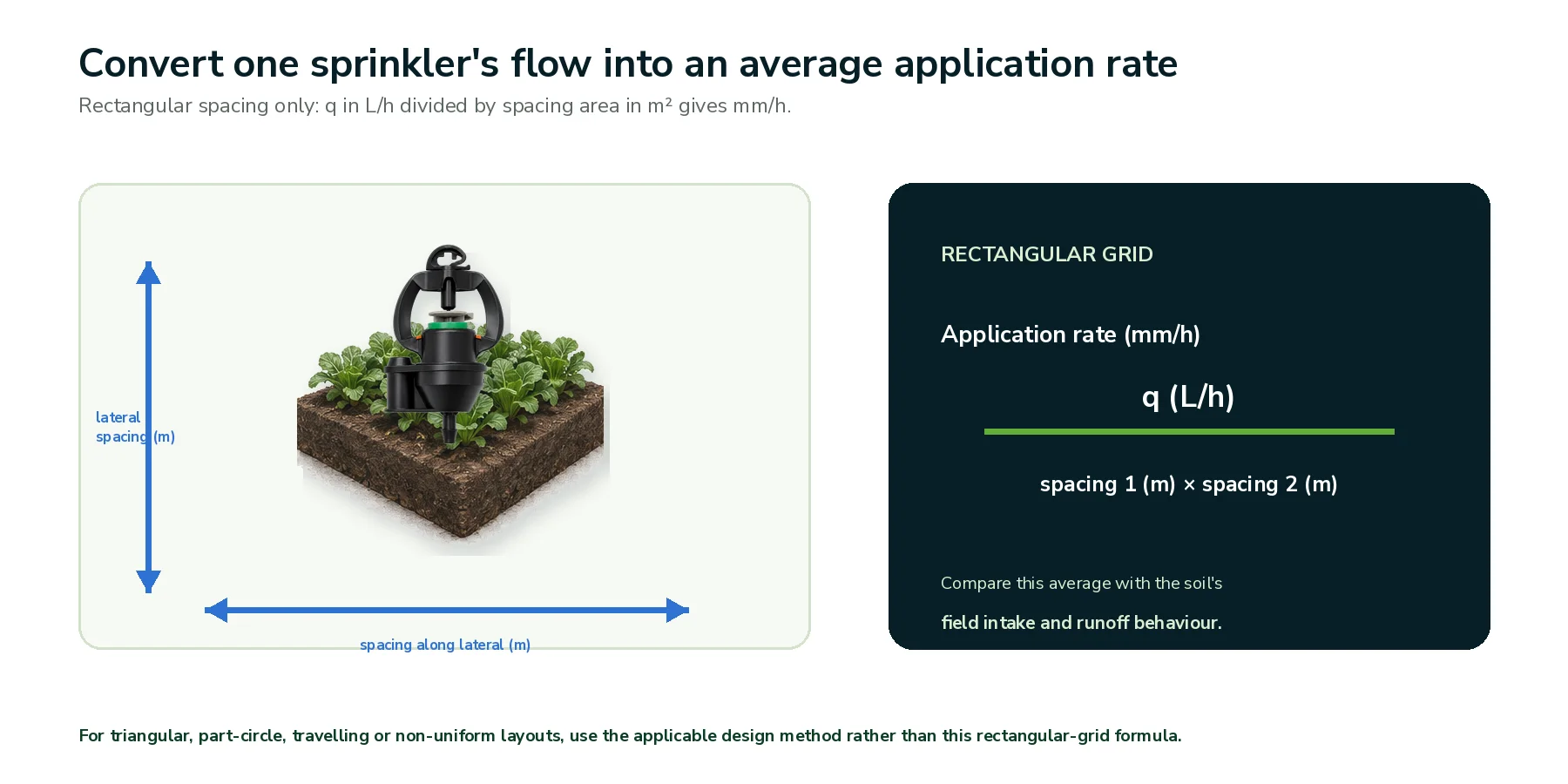
Runtime relationship
Once an appropriate gross irrigation depth has been set from crop water need and soil-water monitoring: runtime in hours = gross depth in mm / average application rate in mm/h. This is a calculation relationship, not a crop watering schedule.
Water path and zoning
Size the sprinkler as part of a complete system
Map the complete water path before sizing any component. A sprinkler that looks suitable can still fail when the source, pump, filter, pipe route or zone count is mismatched.
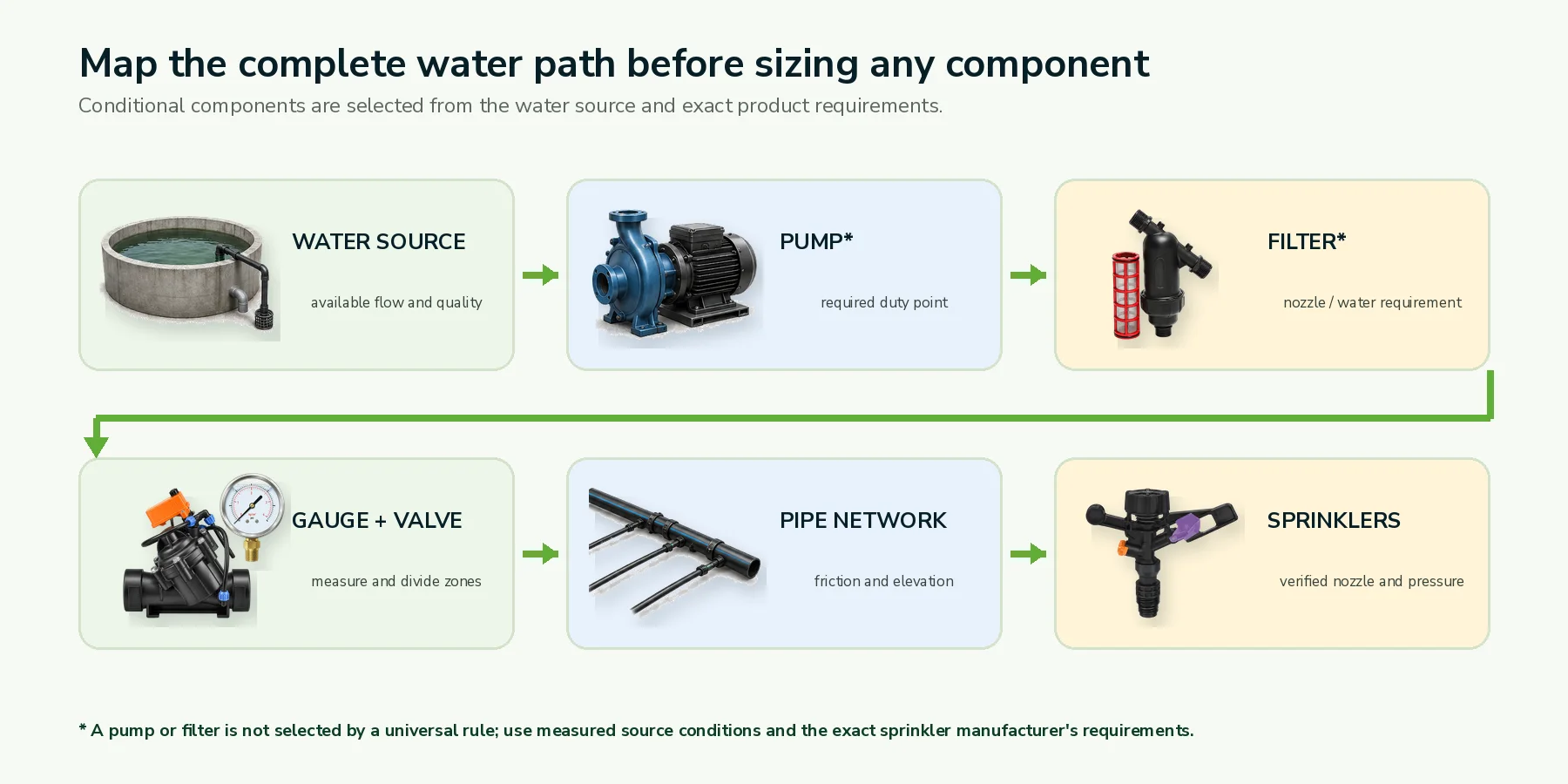
Useful layout worksheet
| Section | Record | Check |
|---|---|---|
| Source | Type, available flow, water level, sediment, algae and operating duration. | Can it sustain the design zone? |
| Head section | Pump if required, shutoff, gauge, filter if required and controls. | Are pressure and flow measurable? |
| Main and submain | Material, internal diameter, route, length and elevation. | Are friction and surge limits addressed? |
| Laterals and risers | Head count, spacing, height, valves and portable connections. | Does every outlet receive the intended pressure? |
| Drain and flush | Low points, safe discharge path and cleaning access. | Can debris and trapped water be removed safely? |
Water quality
Match filtration and maintenance to the water and nozzle
Suspended sediment, organic matter and precipitated material can obstruct sprinkler nozzles, valves or small passages. The appropriate treatment depends on the water condition and the exact nozzle opening and filtration requirement.
| Observation | What it may indicate | Planning response |
|---|---|---|
| Visible sand or silt | Mineral particles entering from the source or pipework. | Provide settling or filtration appropriate to particle load and nozzle requirement. |
| Algae or organic debris | Open tank, pond or canal contamination. | Use treatment and filtration suitable for the organic load; keep the source and screens maintained. |
| Repeated mineral scale | Dissolved constituents precipitating inside the system. | Test the water and use a verified treatment method compatible with crop and equipment. |
| Nozzle blockage | Inadequate filtration, pipe debris, scale or damaged parts. | Isolate safely, clean correctly and correct the source of debris. |
| Different nozzle openings | Different products have different clogging risks. | Use the strictest verified requirement within a mixed zone or separate the zones. |
Do not enlarge a blocked nozzle
Drilling or forcing a hard object through an orifice changes its discharge and pattern. Clean or replace the correct part without altering the opening.
Catch-can check
Test the installed distribution with collectors
For a stationary layout, place identical collectors on an equal grid within a representative overlap area. Run the normal zone at its intended pressure, record wind and runtime, and measure every collector.
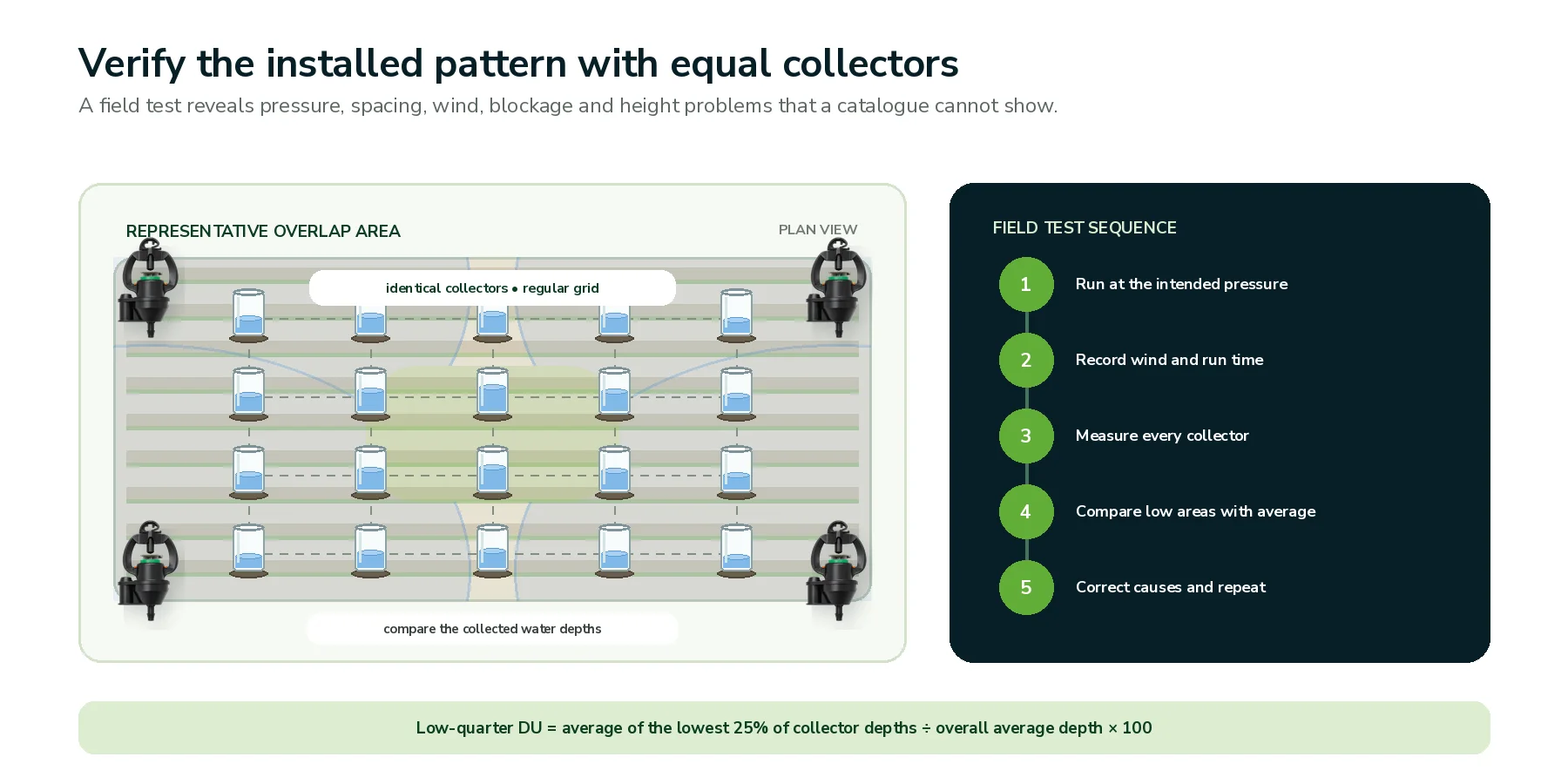
Use the result diagnostically
A single percentage is not a complete pass/fail rule. Compare the result with the design basis and repeat after correcting pressure, nozzles, spacing, height, blockage or wind-related operating conditions.
Common symptoms
Troubleshoot from measurements, not guesses
| Symptom | Checks in a sensible order | Avoid |
|---|---|---|
| Weak throw or large drops | Gauge pressure at the head; confirm nozzle; inspect pump, filter, valves, friction and leaks. | Changing the pump before measuring the zone. |
| Fine mist close to head | Compare pressure with product range; confirm nozzle and regulator; observe wind. | Assuming more pressure always gives more usable radius. |
| Dry bands between heads | Check spacing, head height, pressure, nozzle identity, rotation and wind direction. | Moving one sprinkler without checking the full overlap grid. |
| Wet spots or runoff | Calculate application rate; inspect overlapping layers, slope, soil surface and runtime. | Increasing runtime to fix nearby dry spots. |
| Remote heads are weak | Measure first and last pressure; check zone count, pipe diameter, length, elevation and blockage. | Choosing only by connection thread size. |
| Head does not rotate | Isolate; check pressure, debris, nozzle, drive arm or internal wear using the product service method. | Forcing the mechanism while pressurised. |
| Nozzles clog repeatedly | Inspect source, filter condition, pipe flushing, scale and particle size. | Enlarging orifices with drills or wire. |
Verified product pathways
Browse current sprinkler catalogue areas
These links lead to current Diyatha catalogue destinations. They do not establish operating pressure, radius, pump size or suitability. Use the product data checks above before making a selection.
All sprinkler products
Sprinkler Irrigation
Main sprinkler irrigation catalogue area for current listings.
Small patterns
Micro & Mini Sprinklers
Smaller-pattern and hanging sprinkler listings.
Rotary impact
Impact Sprinklers
Current impact sprinkler listings for overlapping rotary layouts.
Large patterns
Rain Guns
Current rain-gun listings for high-flow large-pattern use cases.
Fine droplets
Sprayers & Misters
Mister and fine-droplet listings for suitable applications.
Protection
Filters and Controls
Filtration, valves and control items used to protect irrigation zones.
Representative current product pages
Direct answers
Frequently asked questions
Which type of sprinkler should I choose?
Choose only after comparing the intended wetted area, crop and soil, water-source flow, operating pressure, wind, terrain and the exact product performance chart.
Can I choose a sprinkler by 1/2-inch or 1 1/2-inch connection size?
No. Thread size does not state nozzle size, discharge, operating pressure, wetted diameter, spacing or application rate.
How far apart should sprinklers be?
Use the spacing guidance for the selected nozzle, pressure and layout, adjust for actual wind conditions, and verify distribution with collectors.
How many sprinklers can one pump run?
Calculate the flow of the operating zone, then compare that flow and the system total dynamic head with the pump performance curve. A maximum-flow label alone is insufficient.
Is a rain gun always best for a large field?
No. Its flow and pressure demand, wind response, application rate, movement pattern and soil intake still have to match the site.
Does a sprinkler system always need a filter?
The requirement depends on water quality, nozzle openings and product filtration requirements. Sediment, organic debris or scale must be addressed before repeated blockage occurs.
Scope note
This page is an educational selection checklist. It does not provide a crop irrigation schedule, site-specific hydraulic design, structural design, electrical design or unverified product performance.